
Rebel Works 2086
This year, the final year IAD designers have been imagining what our futures may hold. Projecting 60 years ahead of the present day, the brief explores what it might mean to contend with large scale societal changes in response to some very real contemporary conversations.
Prelude.
From 1990 to 2010, global manufacturing shifted dramatically. China and India grew to produce over 60% of the world’s goods, while production in the United States and Western Europe declined sharply. On April 2, 2025, President Donald Trump declared “Liberation Day,” announcing unilateral import tariffs on all foreign goods; a move that destabilised global markets and initiated decades of economic uncertainty.
In the UK, similar populist movements gained momentum, promoting visions of self-reliance and national production. Yet, as automation advanced, the manufacturing jobs once promised never returned. Over the following decades, the gap widened between the nation’s financial centres and its post-industrial towns. Wealth inequality deepened, and a new social divide took hold.


2040
By the 2040s, sustained automation had replaced much of human labour. Economic and political instability led to further centralisation of power. In 2065, the UK government introduced a Universal Income Scheme — not as liberation, but as control, designed to quell unrest and enforce social compliance. Energy was scarce, food synthesised, and human survival depended on adherence to state systems.
As the decades passed, small groups began to resist this regulated existence. Some sought renewal, others chaos, but each searched for meaning beyond survival, rekindling fragments of human purpose that the automated world had forgotten.


Introduction
By 2086, rebellion has shifted from protest and revolution to acts of resistance and renewal. In a world sustained by automation and energy control, small collectives have formed — groups seeking identity, purpose, and freedom within the cracks of regulated life. Some are restorative, others disruptive; all exist to reclaim what it means to act with intention.
Acts of rebellion take many forms: moments of care, preservation, creation, or indulgence. Each responds to aspects of the world that remain — social, environmental, cultural, technological, and political. Within this context, you have been tasked to design a spatial proposition for one such group: a place where their values, rituals, and collective identity take physical form.
Your project will begin by exploring aspects of this future world, defining the motivations of your chosen rebel group and the significance of their symbolic object. From these, you will develop conceptual and spatial ideas that shape how architecture can give form to belief, action, and expression.
Your proposal will occupy and transform a site in Nottingham, responding to the physical and cultural conditions of a redundant structure — a structure reimagined as a fragment of future collective life.

Rebel Groups and Symbolic Objects.
Each project will be guided by a chosen rebel group and its corresponding symbolic object. Together, they act as catalysts for research, interpretation, and early design experimentation. The rebel group defines the collective ethos — its desires, values, and purpose — while the symbolic object translates those ideas into tangible form, becoming a key source of material, spatial, and cultural inspiration.
You may choose one of the suggestions; however, you may also define your own rebel group and symbolic object, provided you demonstrate rigorous research and conceptual clarity. The symbolic object may be historical or conceptual, drawn from a single existing artefact or developed through the reinterpretation of multiple historical precedents. If you develop your own, ensure it aligns with the context and narrative of this brief, maintaining relevance to the speculative world of 2086.
When selecting your object, consider how it operates within your group’s culture and rituals. Is it functional, serving as a tool, device, or mechanism for survival? Is it spiritual or mythical, an artefact of belief, memory, or ceremony? Or is it ritualistic, a symbolic prop in acts of defiance, reflection, or care? You are encouraged to define this relationship yourself and express it through making and interpretation.
Functional Requirements.
The spatial and functional requirements will depend on your project narrative and your own interpretation of the subject matter.
As a minimum, the proposal will include:
-
Individual act — function and space for reflection or personal experience.
-
Collective act — function and space for gathering or shared activity.
-
Storage or presentation of the symbolic object — meaning or presence of the symbolic object is made physical.
Site.
The site for this year’s project is the Lace Market Car Park in Nottingham, a structure once emblematic of modern mobility and convenience. Built during an era that prioritised cars over people, it embodied a city defined by private movement, and private ownership.
In the decades that followed, Nottingham’s shift toward shared transport and low-carbon living steadily reduced car use. City initiatives promoting car sharing, public transport, and micro-mobility reshaped urban life, while rising population density led to the pedestrianisation of streets and the creation of new parks and green corridors. The city became increasingly walkable and human-scaled. By the mid-century, the car park, once a symbol of independence, had become redundant.

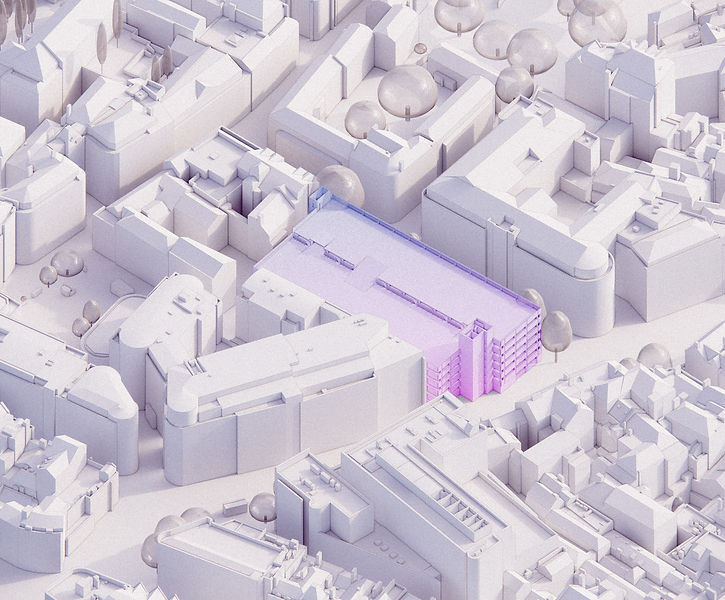
Selective Removal.
By 2086, the Lace Market Car Park stands as a monument to this past system. Its ramps, slabs, and columns trace a once-optimistic faith in progress, now awaiting reinterpretation. Your project will reimagine, inhabit, and transform this structure, working within the constraints and opportunities of what remains. As part of this process, you are required to reduce the building’s mass by approximately 80%, determining what to remove and what to retain in response to the imagined world you construct, whether this change arises from broader social and environmental conditions or from the actions and values of your chosen rebel group.
This act of reduction should be understood as a creative decision, not a technical one. It offers an opportunity to rethink material, space, and narrative: to explore how fragments, voids, and traces of the existing structure might become part of a new architectural language, as well as spatial opportunities that embody the project’s conceptual intent. Elements of the original building can be reimagined, reassembled, or abstracted, forming new relationships between memory, material, and form.

